
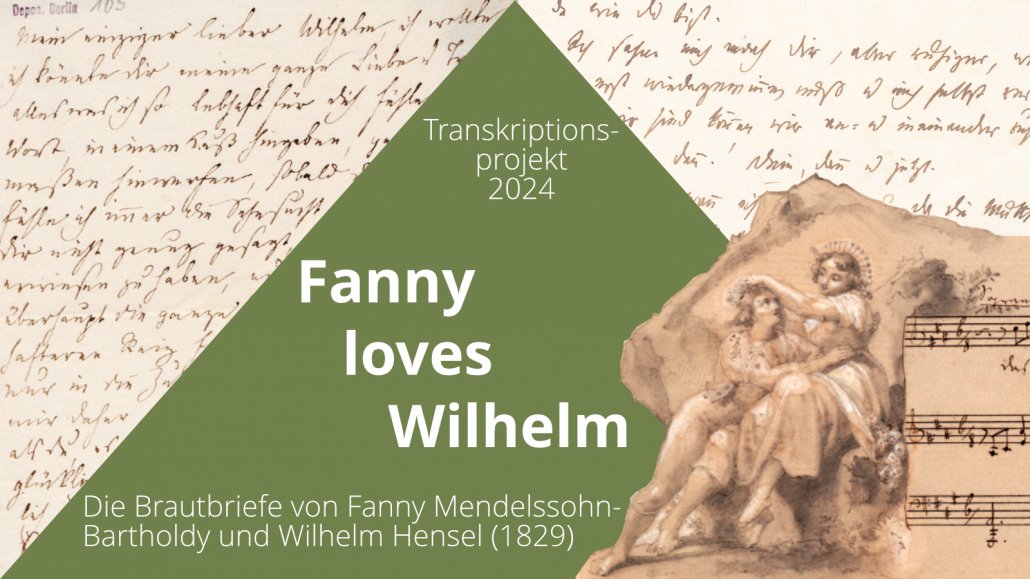
Transcription project of the bridal letters of Fanny Mendelssohn-Bartholdy and Wilhelm Hensel
Starting in the summer semester of 2024, the Music Department of the Staatsbibliothek, a seminar group from the Berlin University of the Arts (UdK Berlin), and the Stabi Lab transcribed, as part of a seminar project, letters and notes exchanged by Fanny Mendelssohn-Bartholdy and Wilhelm Hensel during the period of their engagement.
The transcription project focuses on three folders containing a total of approximately 220 letters:
Briefe und Billets an Wilhelm Hensel aus der Verlobungszeit 1829 (Mappe 1) (MA Depos. 3,4)
Briefe und Billets an Wilhelm Hensel aus der Verlobungszeit 1829 (Mappe 2) (MA Depos. 3,5)
Briefe und Billets an Fanny Hensel aus der Verlobungszeit 1829 (MA Depos. 3,6)
The letters are distinguished above all by the fact that they convey the fiancés’ rapid, day-to-day, often confidential and intimate exchange in an unfiltered manner. The letters and notes are short—rarely longer than a single page—and were usually delivered directly to the respective addressee by servants. In this respect, they can readily be compared to today’s text messages in the way they combine everyday matters (from scheduling arrangements to complaints about toothaches), small tokens of affection, and declarations of love.
Transcriptions
The seminar primarily focused on Fanny’s letters—not least because her handwriting is considerably easier to decipher than Wilhelm’s. The completed transcriptions of all 122 of Fanny’s letters have been published as a dataset and form the basis for the full text of the letters as presented in the Staatsbibliothek’s Digitized Collections. The letters are thus also accessible via full-text search.
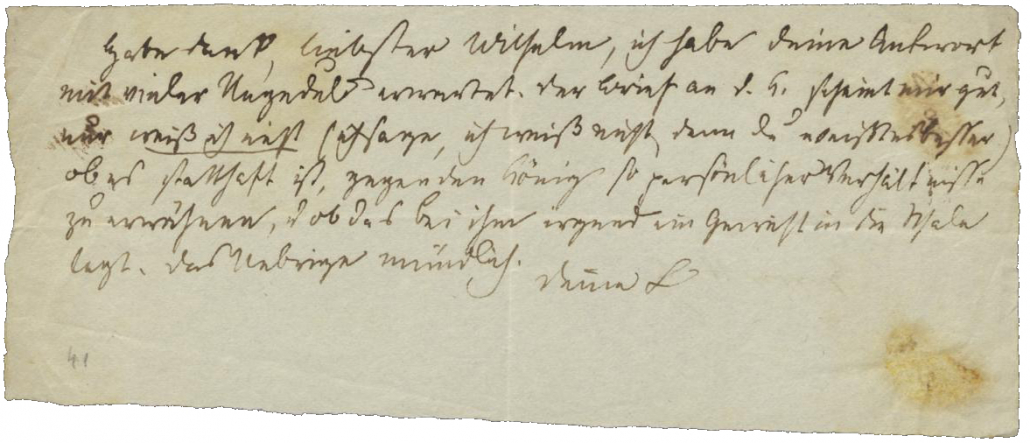
All transcriptions of Fanny’s letters have been published as a freely accessible dataset:

HTR modell training
Since Fanny’s letters and their transcriptions constitute a substantial body of training data for automatic handwriting recognition—here specifically tailored to an individual hand—it is possible to train a dedicated handwriting recognition model (or to further train an existing model). This is particularly worthwhile given that the Staatsbibliothek holds a great deal more handwritten material in Fanny’s hand. With an appropriate model, a usable automatic transcription could be generated relatively quickly. In the course of the transcription project, a free, generic model was fine-tuned to Fanny’s handwriting and produced very satisfactory results on several test pages (which were not used for training).
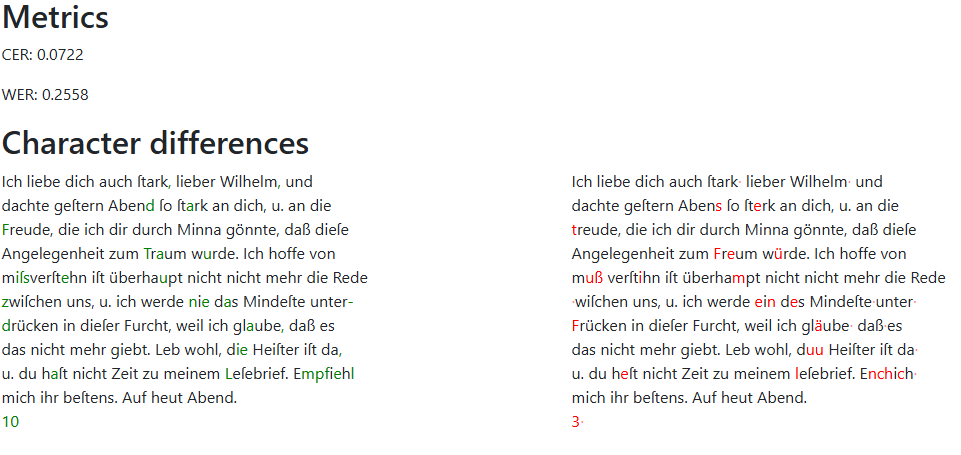
To evaluate our results, we used dinglehopper, an in-house development of the Staatsbibliothek. On five randomly selected test pages, the model achieves an accuracy of over 90% (CER 0.94), meaning that 90% or more of the characters are correctly recognized.
By way of example, a letter page is shown here in the evaluation tool. On the left you see our transcription (ground truth), and on the right the text ‘read’ by our model from this letter page, with the respective deviations highlighted in green and red.
Our model for recognizing Fanny’s handwriting has also been published as freely accessible:

Sorting letters
As mentioned, Fanny’s and Wilhelm’s letters are preserved in three folders, which also form the basis for the three digitized objects in the Staatsbibliothek’s Digitized Collections. Within these folders, the letters are numbered; however, the order clearly does not reflect the actual sequence of the correspondence. As a result—and due to the division of the folders by sender—the correspondence is difficult to read in the rapid back-and-forth exchange that is one of its defining characteristics.
Not in all cases the correct sequence of the letters can be reconstructed from internal evidence. During an intensive block session of the seminar, however, it was possible to reconstruct several strands of the correspondence.
In order to make such excerpts from the correspondence visible as ‘virtual’ digital objects, the Stabi Lab tested methods for creating dedicated IIIF manifests for these (or similar) cases. These manifests reference the original digitized items and extract individual components from them. The following example shows a short excerpt from the correspondence in which one of Wilhelm’s letters is immediately followed by Fanny’s reply, which in turn is answered by Wilhelm. The transcriptions can be accessed as annotations via the menu in the viewer.

