

Colonial Traces at the Spree
An edit-a-thon on the Berlin
Seminar for Oriental Languages
1887-1942
From 29 January to 19 February 2026, the Stabi Lab of the Berlin State Library and the Secret State Archives Prussian Cultural Heritage Foundation invite you to the edit-a-thon “Colonial Traces on the Spree — An Edit-a-thon on the Berlin Seminar for Oriental Languages.”
Get to know how to work with historical archival records and help make visible the colonial entanglements of the Berlin Seminar for Oriental Languages between 1887 and 1942. Together, we will examine the digitized personnel files of the Seminar and close data gaps concerning the non-German instructors of Arabic, Turkish, and Swahili, both in the Integrated Authority File (GND) and in Wikidata.
The edit-a-thon will take place at the Secret State Archives in Berlin-Dahlem as well as at the Stabi Lab of the Berlin State Library (Unter den Linden).
The events and workshops will be held in German. If this presents a barrier to your participation, please feel free to get in touch with us.
Schedule
| 29 January 2026 2–5 p.m. | Kick-off event | Geheimes Staatsarchiv, Berlin-Dahlem |
| Individual working phase | ||
| 5 February 2026 2–5 p.m. | Workshop | Staatsbibliothek zu Berlin, Haus Unter den Linden |
| Individual working phase | ||
| 9 February 2026 2–5 p.m. | Workshop | Staatsbibliothek zu Berlin, Haus Unter den Linden |
| Individual working phase | ||
| 19 February 2026 4–5:30 p.m. | Closing event | Geheimes Staatsarchiv, Berlin-Dahlem |
Making history visible
Coming to terms with the history of German colonialism is a task shared by cultural heritage institutions and society as a whole. Debates surrounding the restitution of unlawfully appropriated objects or the handling of colonial ideologies shed light on the entanglements of collecting institutions in the history of colonialism at the end of the nineteenth century and in the first half of the twentieth century. The edit-a-thon “Colonial Traces at the Spree” invites participants to engage with the history of the Berlin Seminar for Oriental Languages, with a particular focus on the Seminar’s instructors (Lektoren), who have received little attention to date.
Join us! Help make history visible and enable research.
The Seminar for Oriental Languages was founded in 1887 at the Friedrich Wilhelm University, later the Humboldt University of Berlin. The Seminar was a training institution with a colonial-political mandate, educating diplomats, civil servants, translators, and missionaries. Among other subjects, it provided instruction in the languages and regional studies of German colonies in Africa and Asia.
From the late 1880s onward, so-called Lektoren came to Berlin to teach languages from the German colonies at the Seminar. Studies on the history of German African or Asian studies, for example, have so far addressed the role of these instructors only marginally. As native speakers and experts in the culture and history of their countries, however, the Lektoren played a key role in preparing German diplomats, civil servants, translators, and missionaries for service in the colonies.
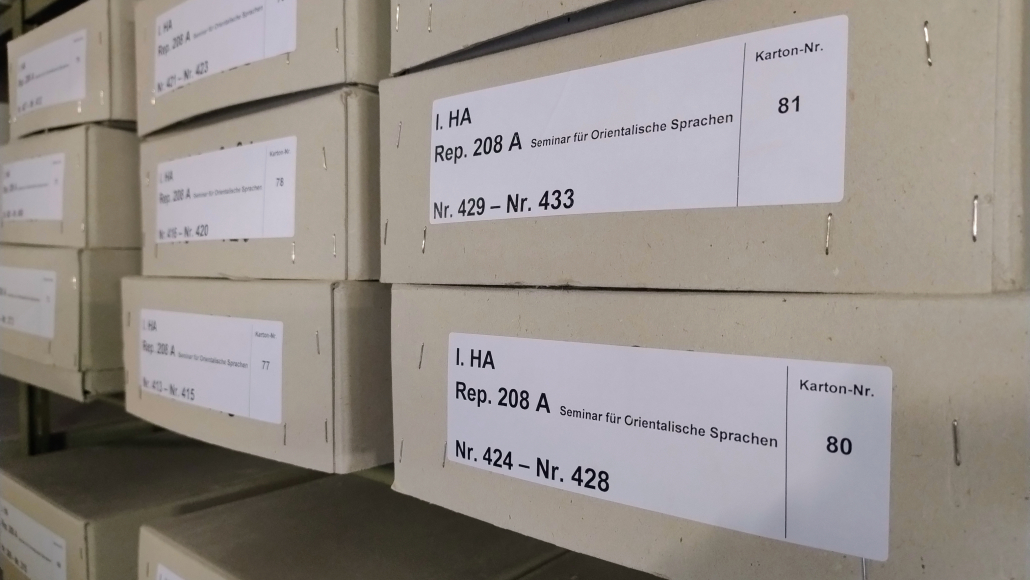

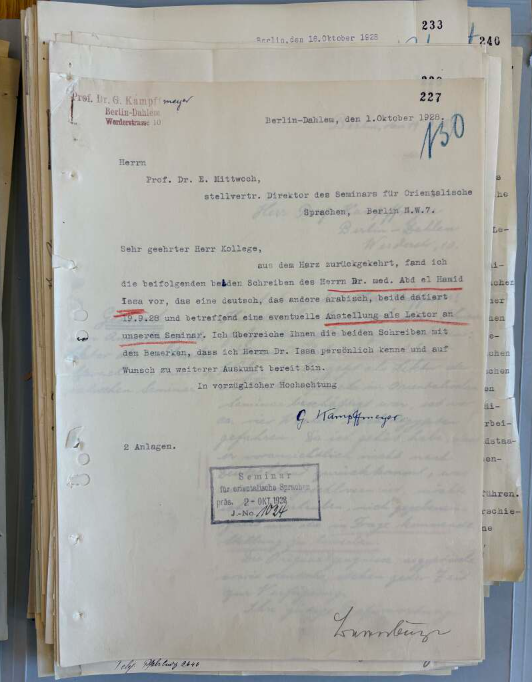

With funding by the Research and Competence Center Digitalisation Berlin (digiS), the records of the Seminar for Oriental Languages have now been digitized. Among the digitized archival materials are the personnel files of the Lektoren who worked at the Seminar between 1887 and 1942. These documents offer insights into the work of the instructors and the circumstances under which they lived in Berlin. During this edit-a-thon, we would like to explore the stories that can be found in the files concerning the activities of the Lektoren, possible conflicts within the Seminar, or moments of anti-colonial activity.
Work with historical records and close gaps in open data
The fact that Lektoren have received little attention in historical scholarship to date is also reflected in open data services. While entries on German individuals associated with the Seminar for Oriental Languages have so far been prioritized in the Integrated Authority File (GND) and Wikidata, corresponding entries for non-German Lektoren are largely missing. The edit-a-thon “Colonial Traces at the Spree” therefore aims to close these gaps, making new connections between the Seminar and the Lektoren visible and enabling further research into the history of the Seminar’s colonial entanglements.
The records of the Seminar for Oriental Languages, of course, offer only a limited view of the lives and activities of non-German Lektoren in Berlin in the late nineteenth and early twentieth centuries. As administrative documents of a Prussian institution with a colonial-political mandate, the Lektoren appear primarily through the language and administrative logic of the Seminar. Against this backdrop, we aim to read these documents “against the grain,” following the approach proposed by the historian Ann Laura Stoler.
Venues
Geheimes Staatsarchiv Preußischer Kulturbesitz
Archivstraße 12
14195 Berlin-Dahlem
U3 Podbielskiallee
Bus X83
Staatsbibliothek zu Berlin
Unter den Linden 8
Raum Oxford
S + U Friedrichstraße
U5, U6 Unter den Linden
Bus 100, 300
Contact
Geheimes Staatsarchiv Preußischer Kulturbesitz
Dr. Ramon Voges
ramon.voges@gsta.spk-berlin.de
Staatsbibliothek zu Berlin
Dr. John Woitkowitz / Dr. Roman Kuhn / Dorian Grosch
lab@sbb.spk-berlin.de

