
Weibsbilder. World Wide Women.
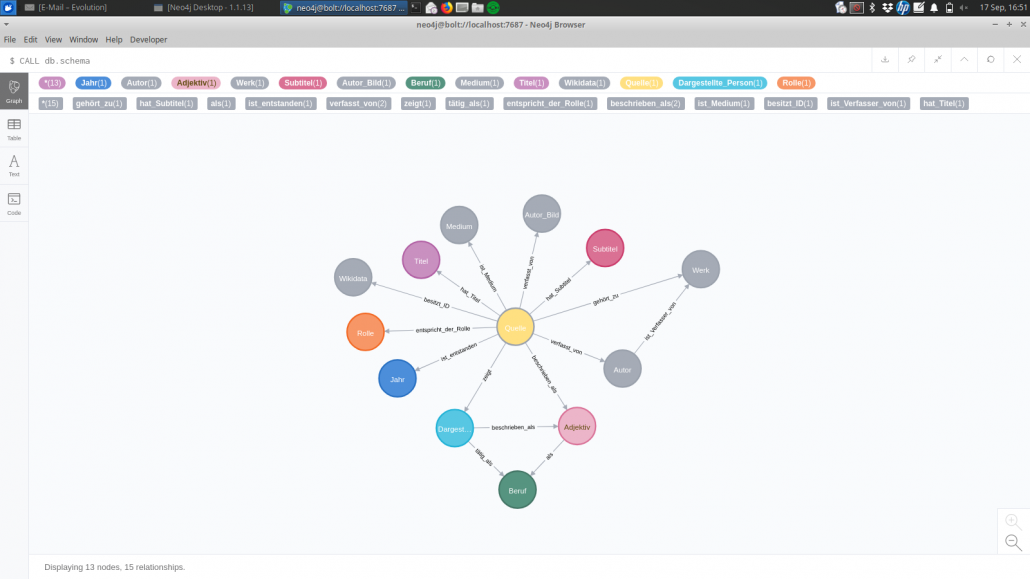
How can role models be represented? What relationships exist between specific role attributions, the activities performed and the source genres? Are there congruences between specific roles and source genres? These questions were answered by the team “Weibsbilder. World Wide Women” in the Hackathon Coding Gender. Based on the data sets Picturing Gender, Dolls Kitchens and Aeroplane Kites and Women in Wartime, these questions were investigated using the graph database neo4j. The available data sets were used to show how women were portrayed in different media at different times and what role attributions were made to them. At the same time, the use of neo4j in conjunction with Wikidata was intended to demonstrate the possibilities of indexing and mediation in order to give more attention and visibility to women and role images in historical sources – in line with the theme of the hackathon “CodingGender”.
Approach
- As a first step, the available data had to be extracted manually from the data sets, from which the property keys “Person”, “Occupation”, “Description” and “Role Assignment” were created. For a possible evaluation of the source genre, also the property keys “Medium”, “Publication”, “Title”, “Subtitle”, “Author” and “Identifier” were created.
- In the second step, the relationships between the nodes were marked. The respective source was described with the identifier of the Berlin State Library’s Digitised Collections in order to be clearly identifiable and verifiable. The descriptions of the women and their role attributions had to be lemmatised before being entered into the database.
- In parallel, the sources were entered as data records (also manually) in Wikidata and Wikimedia with their corresponding statements (inventory number, GND-ID etc.). The identifiers of the digital collections of the Berlin State Library were also used for the individual sources. The respective unique identifier from Wikidata was then assigned to the respective source in neo4j.
With just a few data sets, the Hackathon project “Weibsbilder – Word Wide Women” wants to show the possibilities of using graph databases in combination with Wikidata: On the one hand the use as a research environment and on the other hand the increase of visibility of women in the World Wide Web. If the project is continued, the development of a user interface would be desirable, both to facilitate the communication of the research results and also to enable the addition of further data/data sets, for example in the context of a Citizen Science project.


Leave a Reply
Want to join the discussion?Feel free to contribute!