
Housing Shortage Tetris
This project was developed during the hackathon Coding Precarity and was awarded by the jury in the category “Best Metaphor”.
Idea and Concept
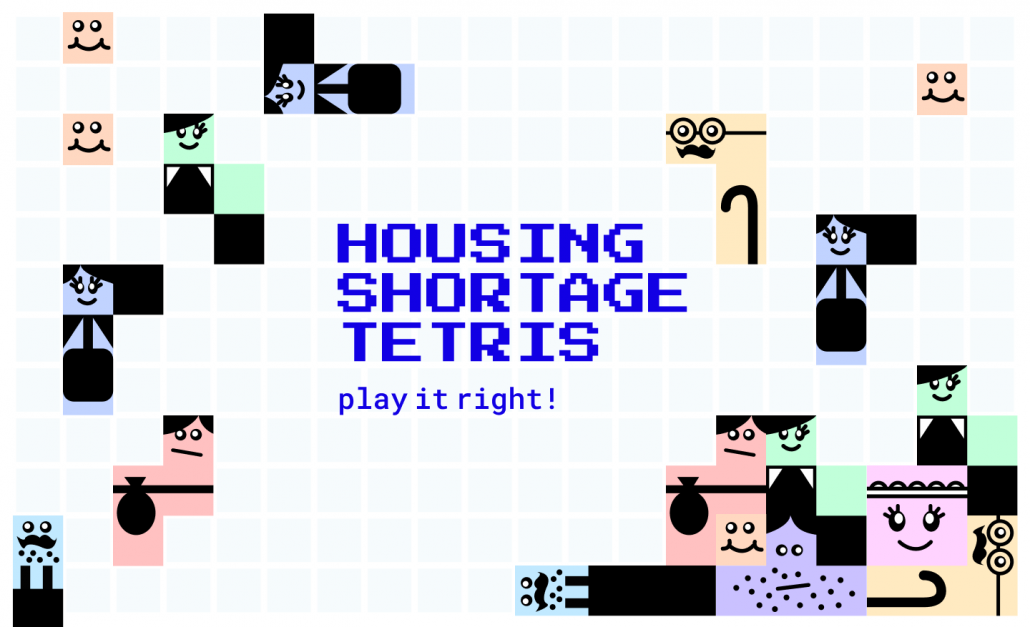
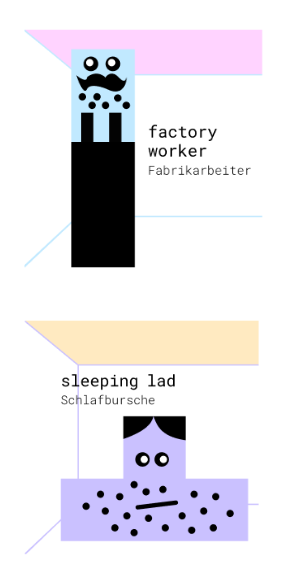
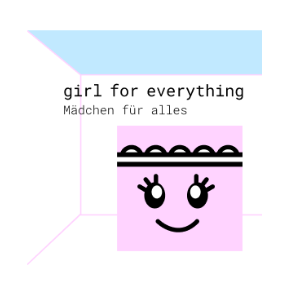
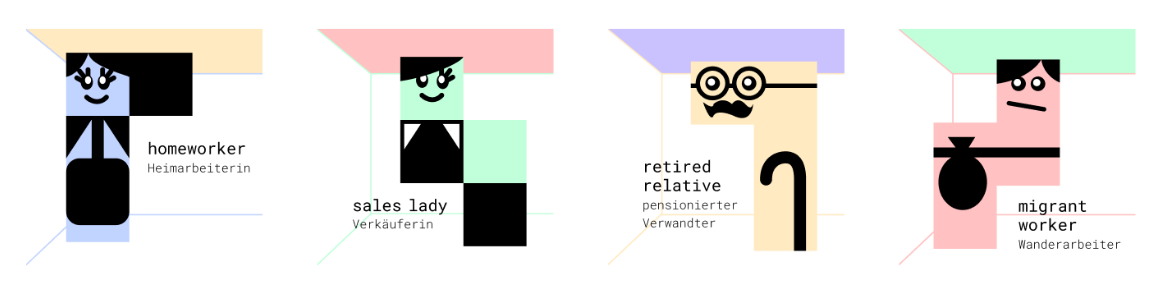
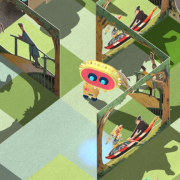
In the Housing Shortage Tetris game, players are requested to place a certain amount of tenants inside a given living space. What comes across as a colourful and popular classic game reveals its conceptual intricacy at a second glance. For the Tetris figures are typical inhabitants of a 19th century town. Here, homeworkers spend the night next to migrant workers, and during daytime the same beds are often rented by the hour to so-called sleeping lads. Saleswomen, girls for everything, and factory workers share the crowded living space with retired relatives and many children. The Tetris game thus serves as a metaphor, visualizing the housing conditions in large cities.
Realization and Implementation
For the realization and implementation we used Figma, a collaborative interface design tool and Godot, an open source game engine. Godot allows for designing Tetris figures individually. We developed nine different figures representing the typical tenement house inhabitants in 19th century Berlin.
With each game level it becomes more difficult to place the necessary number of tenants inside the given living space, as their number and speed is constantly increasing. Through this gamification approach, the important (and today again extremely prevailing) issue of affordable and appropriate housing might also reach politically less informed groups.
Outlook
The Tetris game idea could be further developed, e.g., by including other housing shortage scenarios provided by the data sets, such as housing conditions in the countryside, in smaller towns or from other metropolitan areas such as Hamburg. Hourly bed rentals to sleeping lads or the accommodation of homeless people in asylums could be modelled into separate playing arenas with their own game logics.
Links
Code
Game on GitHub (https://brunibrun.github.io/CodingPrecarity)
Project on GitHub (https://github.com/brunibrun/CodingPrecarity)
Gameplay video:
Team
The team behind Housing Shortage Tetris is: Bruno Puri (B.A. in Computer Science, Technische Universität Berlin), Maryna Honcharenko (Interface B.A., FH Potsdam), Manuel Pfeuffer (M.Sc. Statistics, Humboldt-Universität Berlin), and Anna Meide (Interface B.A., FH Potsdam, https://www.instagram.com/meideanna).
More outcomes of the hackathon Coding Precarity can be found here.






Leave a Reply
Want to join the discussion?Feel free to contribute!